


Our Guide to Telemark Skiing.

Telemark skiing is fun and versatile, opening up for easy backcountry access and free opportunities for roaming a varied terrain. Due to the techniques necessary to master telemark skiing, it’s also a challenging and demanding effort. This guide to telemark skiing delves into all of this, offering a comprehensive introduction to telemark ski equipment, techniques, and tips.
What is Telemark Skiing?
Telemark skiing is a ski style that blends alpine and Nordic skiing. It’s defined by the so-called «free heel» turn, also known as the Telemark turn, where the skier drops the back knee and steps forward when going downhill. This squat-like motion is a way of moving low, connected to the snow, enabled by the toe-only bindings.
Key Characteristics of Telemark Skiing.
-
Free heel: The bindings of the ski attach only at the toes, which increases the mobility of the heel.
-
Telemark turn: The key characteristic of telemark skiing: A deep lunge where the outside ski is forward, the inside ski trails, and the weight shifts to the downhill foot.
-
Hybrid style: Combination of cross-country and downhill skiing techniques and style.
Historical Backdrop.
The history of telemark skiing starts in Norway, the homeland of Db Journey. More specifically, the name originates from the Telemark region of Norway, a known area for mountains, snowy landscape, and both cross-country and telemark skiing.
A Telemark-native, Sondre Norheim, raced in local ski competitions with what we know today as telemark techniques and equipment. He held his balance and handled turns elegantly by bending his knees deeply, facing his torso downhill, and thrusting his ski forward and pointed into the turn. He also innovated wider skis and telemark bindings, which are characteristics of this ski style. They hold your toes in place, but allow your heels to rise when skiing flat or uphill. Therefore, you can say that he’s quite the pioneer of modern skiing.
Since Sondres wins in the local Norwegian slopes (circa 1860s), telemark skiing as we know today has developed into more advanced gear and equipment and the interest has grown. Although not as popular as alpine skiing, many pick up their telemark skis when they want a backcountry adventure.
Also read: Our guide to backcountry skiing

What is the Point of Telemark Skiing?
The point of the telemark – or why many choose this ski style – is to combine the joys of cross-country skiing with the adventure of downhill skiing. You are able to carve down slopes precisely, while still having the opportunity to travel in uphill and flat terrain. This makes for a possibly adventurous and versatile ski experience, where you can escape into the backcountry and move smoothly through the snow.
Telemark Skiing Equipment.

Telemark Skis.
Telemark skis resemble alpine skis, but differ of course. Both skis are designed to take you downhill smoothly, but telemark skis are also meant to take you easily uphill and across flat terrain as well. For that reason, they are lighter than alpine skis and are installed with the signature bindings that allow you to move your heels freely.
Within telemark skis there are some differences as well. Some are wider than others, while some are narrower. We’ll give you the breakdown next.
Categories of Telemark Skis.
Freeride skis.
- Width: Medium-width.
- Terrain: Suited for mixed terrain.
Sports and racing skis.
- Width: Narrow.
- Terrain: Suited for tracks and built for precise and speedy descents.
Backcountry skis.
- Width: Wide, but light.
- Terrain: Suited for touring and off-piste terrain.
Powder skis.
- Width: Wide.
- Terrain: Suited for deep snow, oftentimes in backcountry terrain.
Pack in Ski Bags.
It can be a pain in the ass to travel with your snow gear. But it doesn’t have to be. Our Snow Roller is a long, compressible ski bag meant to streamline the packing and transport of skis and ski poles. It’s a spacious bag with compartments that also facilitate space for extra layers. Additionally, its puncture-proof wheels pave the way for a smooth journey.
The Snow Essential Ski Bag is a more pared-down, but equally functional ski bag for travel. Its straps are easy to adjust and fit comfortably on your shoulders when you’re on the go. It is also available as a snowboard bag.

Bindings.
As with the telemark boots, the bindings are flexible and designed to handle a free heel and easy movements uphill, across flat terrain, and steep descents.
Types of Telemark Bindings.
-
Classic duckbill bindings: Asymmetrical bindings, requiring adjustment in accordance with the length of your boots.
-
Modern NTN bindings: Symmetrical bindings, meaning that both the left and right skis are completely the same.
Telemark Boots.
Telemark ski boots are flexible, but vary in stiffness. The more flexible they are, the more comfortable, but stiffer boots can increase the responsiveness between your movements and the skis. In other words, stiffer telemark boots can give a better sense of control of your skis. However, as a beginner, you will benefit from the comfort of flexible boots, meaning that a mid-range flexibility in telemark boots is recommended. Professionals also recommend that you pay extra attention to the width of your feet and choose boots that are aligned with this.
Take Advantage of Boot Bags.
A solid boot bag should do more than just carry your gear – it should simplify the entire day. Our ski boot bags are shaped to fit your boots securely, provide space for essentials, and stay comfortable to carry through airports, parking lots, or resort villages.
Built for boots and all your snow-day gear, the Hugger Bootpack 45 L is durable, spacious, and ready for rough conditions. It features a 45 L main compartment, a full-zip front panel that doubles as a changing mat, and a water-resistant, wipeable interior for wet or muddy boots.

Telemark Skiing vs. Alpine Skiing.
When you do telemark skiing, the heel is free and not fixed to the ski, allowing for deep turns and easier uphill climbs. You achieve a more comprehensive and flexible backcountry experience, having the freedom to move along the terrain as you please.
By contrast, the heel is locked to the ski during alpine skiing, because this leverages the power to a maximum, ensuring speedy descents and powerful turns. Exactly this, carving turns along groomed trails is the key characteristic of alpine skiing. It is mostly done at ski resorts, focusing on the downhill experience.
Finally, telemark gear is more flexible, where the boots are lighter and the bindings are not locked to the ski or boot. Alpine gear is heavier, with stiffer boots and locked bindings.
Choose Telemark or Alpine. How?
If you love going uphill, prefer gliding fluidly and freely along the terrain, and seek backcountry adventures – choose telemark skiing.
If you prefer ski resort adventures, speedy trails, and carving along the slopes with maximum control and precision – choose alpine skiing.
Read also: Our guide to alpine skiing
Telemark Skiing vs. Cross-country Skiing.
Telemark skiing offers the happy medium between cross-country skiing and downhill. For one, telemark skis use free-heel bindings similar to cross-country ski bindings, and offer much of the flexibility as cross-country skis. That being said, the telemark skis are stronger and often wider than cross-country skis. Cross-country skis are designed to be moved along flat terrain and groomed and rolling trails. The sturdiness of telemark skis offers the option to do steep descents and slide more easily in ungroomed terrain.
Packing Your Gear in Our Ski Bags.
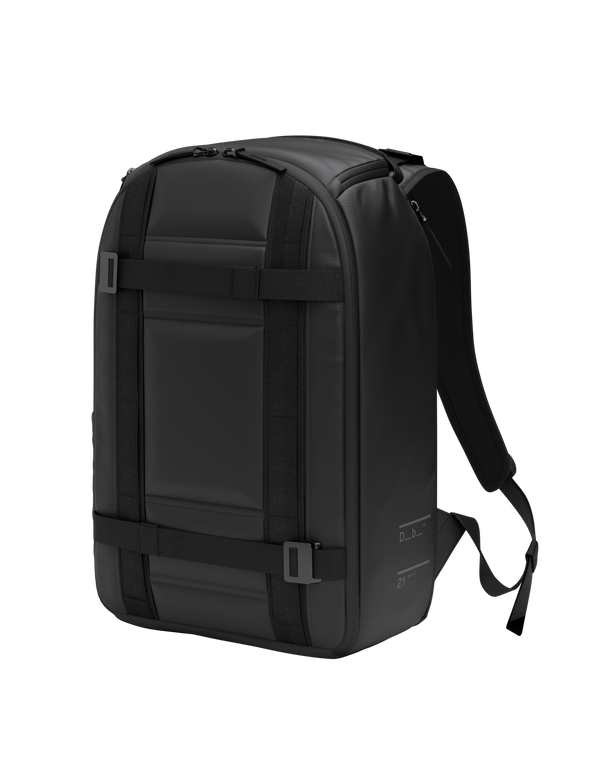
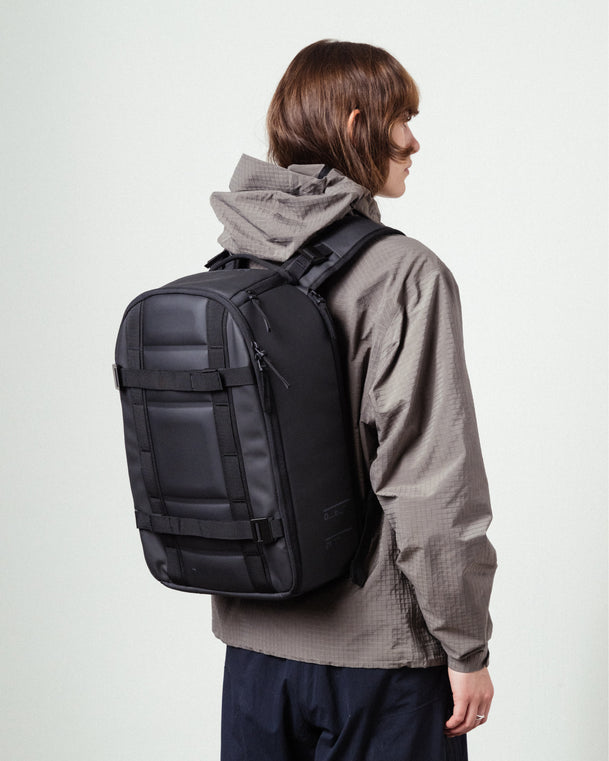
A backcountry adventure isn’t just about getting down the steep descents – it’s about carrying the right gear, staying organized, and doing it comfortably. Whether you need a small backpack for day trips or a full-sized ski carrying backpack for backcountry adventures, we have a pack to match your style and needs.
The Hugger Backpack.
A versatile all-rounder for day trips: Our Hugger Backpack features a roll-top design to expand or compress volume, multiple compartments for gear organization, and padded straps for comfortable carrying. Durable materials keep your equipment safe, whether you’re hitting the slopes or exploring town.
The Backcountry Backpack.
The Backcountry Backpack is the perfect ski and snowboard backpack for off-piste journeys and life off the mountain. The slim-fit design makes it lift-friendly and easy to handle on the slopes and the designated internal avalanche compartment secures the safety of your journeys.

Is Telemark Skiing Hard?
Yes, it’s true what they say that telemark skiing can be hard. For one, it is physically straining, requiring you to rely on strong quads, glutes, and hamstrings, and secondly, it’s all about the techniques. You need to master the four-step techniques for telemark skiing (more on this next!). That being said, it’s a very rewarding feeling when you actually get it. Having the option to ski uphill and downhill on the same skis, without changing boots or bindings, is a huge upside, making it a joy to ski off-track and in the backcountry.
Techniques for Skiing Telemark Successfully.
1. Initiating the Stance.
Start with standing tall and upright before you sink into a squat and bend both legs. Feet should be hip-width apart to be stable. Slide your front foot forward and move your back foot behind you. The back heel should lift up, while the front foot is completely flat.
2. Turning.
Lead change when you get ready to turn, and bring your trailing leg forward while dropping your back knee as you turn. The key to Telemark turn is bedding your knees, as opposed to alpine skiing where much of the magic happens in the ankle movement.
3. Putting Pressure.
Put pressure on the ball of your front foot when going downhill.
4. Releasing and Repeating.
Release pressure to bring skis together before you take on the next turn. Repeat this four-step process of squatting, leaning into the turn, and maintaining resilience out of the turn and as you prepare for the next one.
Where to Telemark Ski?
Ready to head out, but not sure where to go? We’ve created many guides to the best European and American ski resorts for ski adventures. Admittedly, they have been more focused on alpine skiing along groomed trails, but there are still recommendations for great backcountry destinations for telemark skiing.
Take a deep dive into our guides for the best ski resorts in Europe and the U.S. below.
Telemark Skiing in Europe.
Telemark Skiing in the U.S.
Read One of Our Other Guides.
Interested in learning more about the basics of backcountry or alpine skiing, or want some expert insight into which techniques to fine-tune? Check out our guides and get inspired for the journey.
Your Questions Answered.
Telemark skiing.
What are the benefits of telemark skiing?
Telemark skiing is a versatile ski style, enabling you to ski in varied terrain easily. It’s also efficient for touring as the heel is free, making it much more flexible compared to alpine skiing. This also opens up for skiing uphill and flat, which is a great advantage when skiing off-trail or in the backcountry.
What are the challenges of telemark skiing?
Telemark skiing is quite physically demanding, as you’re in a squatting position most of the time, leveraging your quad muscles. It can also be tough on the knees, specifically while touring.
Is telemark skiing better for your knees?
Telemark skiing can tear on your knees, but compared to alpine skiing it can be better for your knees, because you increasingly build stable muscles, distribute weight more evenly, and encourage smoother movements. As with any activity, this depends on your ability to perform the techniques correctly.
Is telemark skiing in the Olympics?
No, telemark skiing is not a sport in the Winter Olympics currently.