- Bestseller
$260
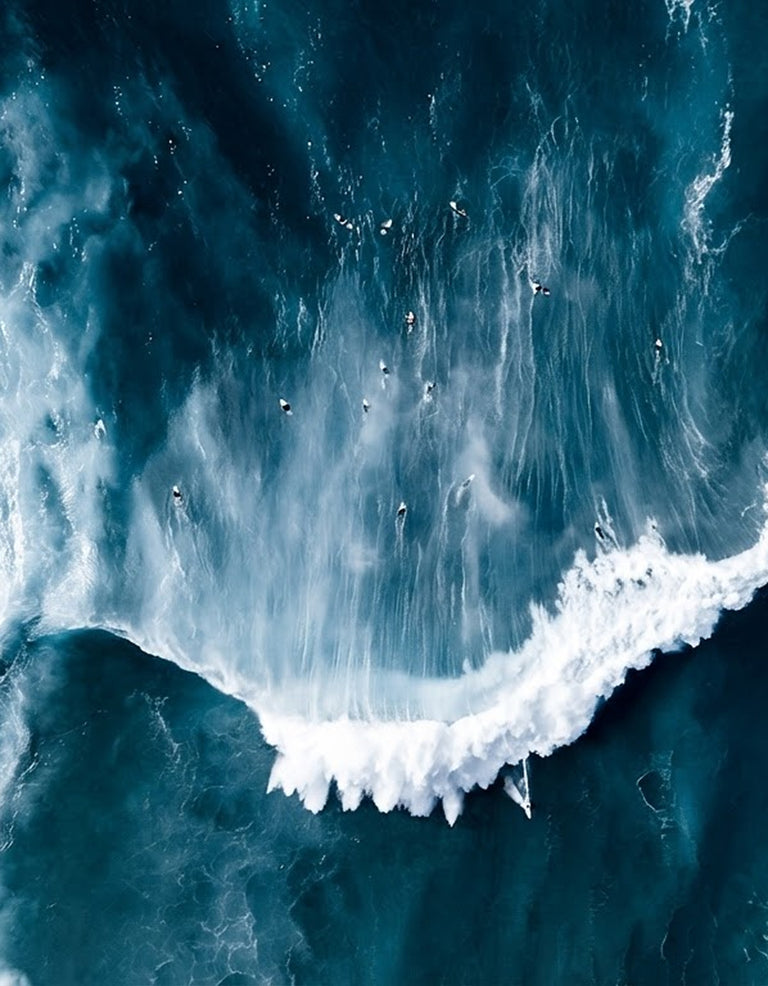
Making a bag means spinning fiber, weaving fabric, coating it, cutting it, sewing it and shipping it. Almost all of that happens in factories we don't own, in Vietnam, China, Taiwan and South Korea.
That's why 99.5% of our climate footprint sits outside our own four walls — in the mills, the factories, the freight and our own travel. Our offices and cars are a rounding error. Any serious effort we make has to reach into other companies' factories, or it isn't a serious effort.
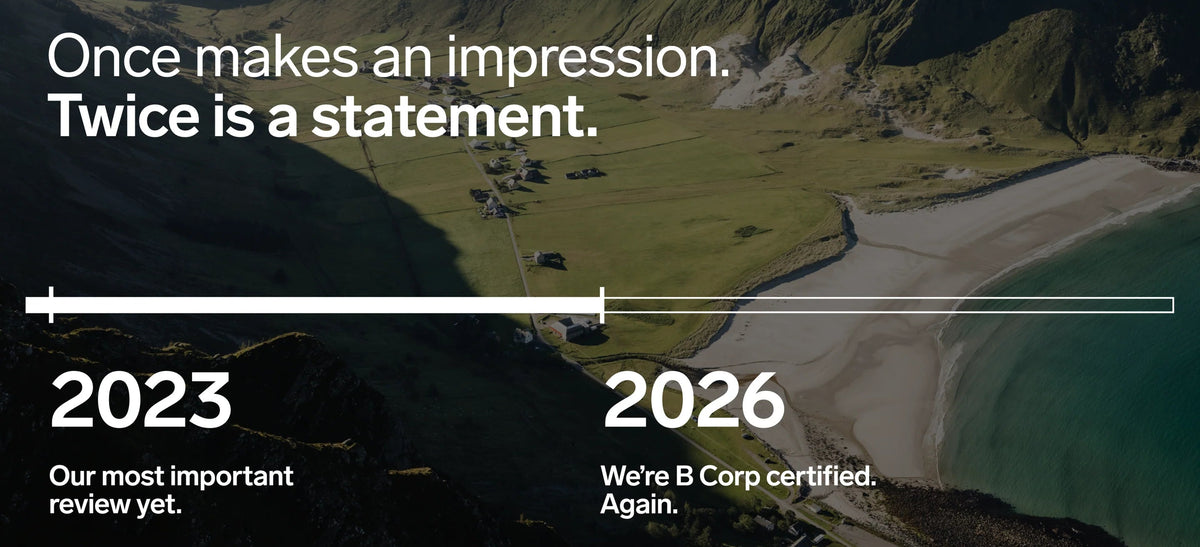
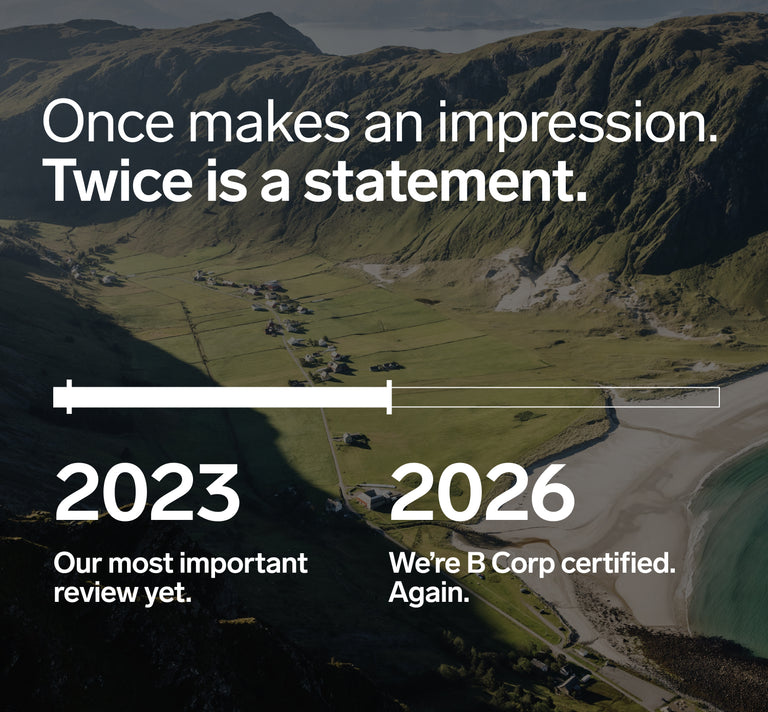
Once makes an impression. Twice is a statement. We’re the first luggage brand to recertify under B Lab’s new standards.B Corp is, in short, a certification for businesses trying to do business better. The whole operation gets put under the microscope. How you treat people, how you affect the planet, how you work with suppliers, how the business is run. And whether the things you say you care about actually show up in the decisions you make.
Basically, B Lab (the organization behind B Corp) looks under the hood.
And ask questions.
A lot of questions.
Enabling meaningful journeys that help people go out into the world and come back with greater perspective. We use our business to create durable travel gear, reduce our environmental footprint, improve conditions for the people in our value chain, and contribute positively to the people we meet and the places we move through.
In practice, the first of those does most of the work: build gear so good you don't replace it. A bag that lasts twenty years and gets repaired twice does more good than a recycled bag replaced after three.
Dyeing and finishing fabric is thirsty work. Here is what we're doing about it.
Our strategy is called Do Better. We launched it in 2020, we update it every year, and it holds every initiative we're running or planning. It's tied directly to our climate action plan, so the initiatives that would cut the most emissions get priority, measured against our emissions data rather than against how visible they are.
Durability and timeless design at the center of how we approach everything we do.
Repair it, trade it in, buy it second-hand. That's Db Lost & Found.
Getting our suppliers onto renewable electricity and out of water-intensive processes.
Knowing who makes our gear, and holding those factories to standards we can check.
In 2025 our total footprint was:
That's our starting line, and everything below is measured from it.
The part that's harder to put on a poster. Our supply chain target is to cut the footprint of each product we make by 7% a year — around 30% by 2030. It comes from STICA, the Scandinavian Textile Initiative for Climate Action, rather than being a number we picked ourselves. It's real, it's measurable, and it's the part we can engineer.
But we also plan to grow. If we sell enough more bags, our total footprint can rise even while every individual bag gets better. On current modeling we expect to end up roughly level with today while the business itself is much bigger. That arithmetic is uncomfortable, and we'd rather you heard it from us than worked it out yourself.
What we do commit to is supporting the global effort to keep global warming below 1.5°C, and doing our share. What we won't do is put a date on Db reaching net zero before we can show you a credible plan for getting there. We'd rather publish the date once we can stand behind it.

All figures cover the financial year 2025 and the Db Equipment AS group. Greenhouse gas figures follow the GHG Protocol and are prepared with 2050 Consulting. Our full disclosures follow the European Sustainability Reporting Standards. Where a number is an estimate rather than a measurement, the report says so.
We support the global ambition to limit warming to 1.5°C. We do not claim to be carbon neutral, climate neutral or Paris-aligned, we don't use carbon credits to make any of those claims, and we haven't set a date for reaching net zero.
For questions, corrections or better ideas: dobetter@dbjourney.com
Join Db Black for member benefits made for frequent travellers.
Sign up now to receive